
Why Iran Must Fall – Part 1: The Villain the West Loves to Hate
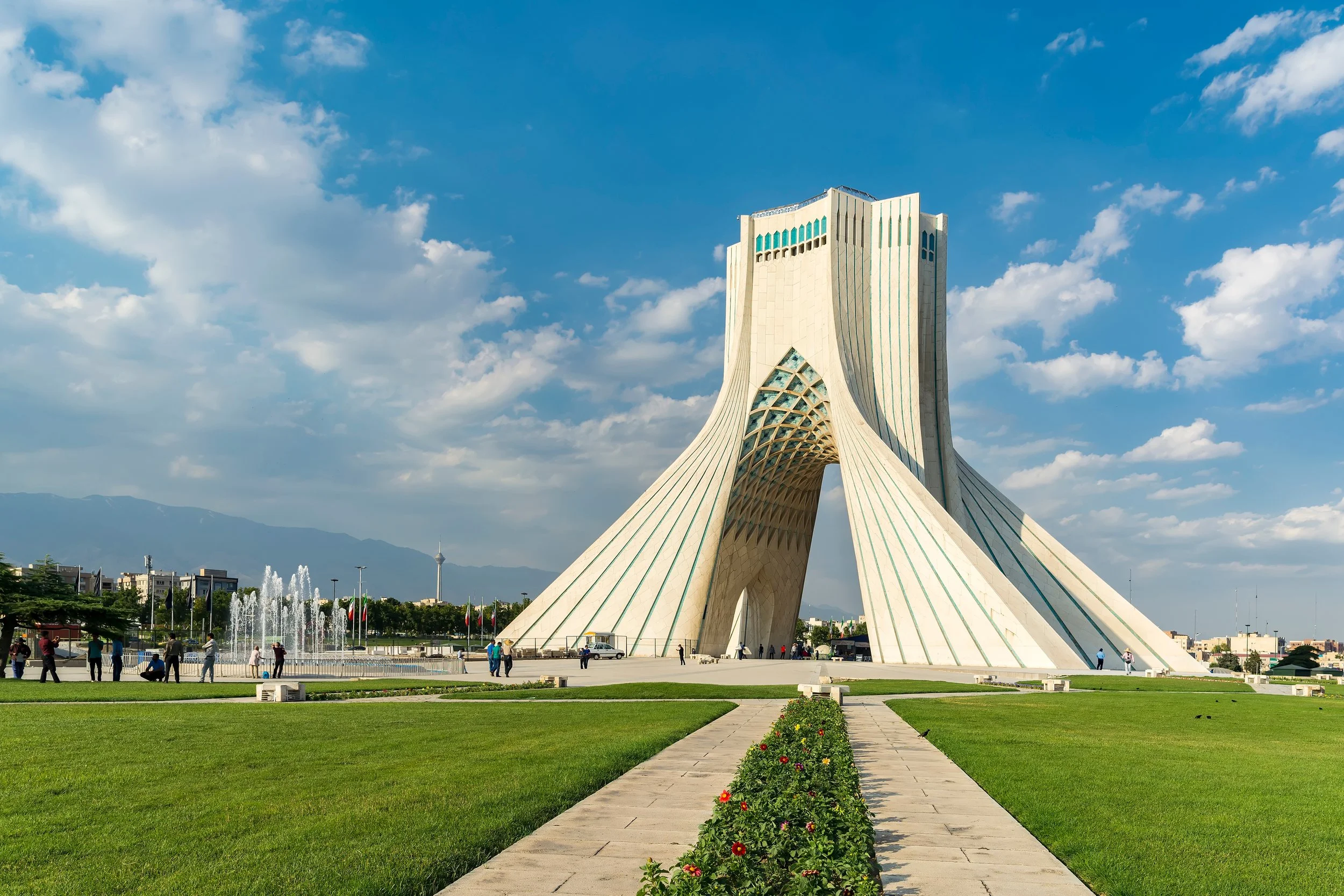
Azadi Tower, also known as Freedom Tower, in Tehran.
The war on Iran is not about nuclear weapons.
Iran is the last power in Western Asia (what the West calls the Middle East) willing to challenge Western dominance. That dominance rests on two pillars: American global hegemony and Israeli regional supremacy.
For Washington, Iran poses a systemic threat to dollar-dominated commerce. Iran sits at the geographic heart of the emerging multipolar order, where China's Belt and Road Initiative intersects with Russia's North-South Transport Corridor. This makes Iran the indispensable link in BRICS trade networks that bypass Western financial control. A sovereign Iran does not merely trade outside the dollar system. It enables dozens of nations to do the same. This accelerates the collapse of the economic foundation that sustains American global power.
For Israel, Iran is the primary obstacle to unchallenged regional dominance. Through its Axis of Resistance—Hezbollah in Lebanon, the Houthis in Yemen, Palestinian factions in Gaza and the West Bank, and groups in Iraq and Syria—Iran prevents Israel from completing three objectives: Palestinian subjugation, unbridled territorial expansion, and economic integration with Gulf monarchies.
These threats are inseparable. American hegemony requires Israeli dominance to control the region's energy and trade routes. Israeli expansion requires American military and financial backing to survive the consequences. Iran disrupts both simultaneously—and for that, it must fall.
Twelve Days That Shook the Middle East
On Friday, June 13, Israel launched an unprovoked assault on Iran. The timing was as calculated as the military strike itself. Two diplomatic processes threatened the existing order, and Israel torpedoed both in a single blow: nuclear negotiations that could normalize Iran's position in the global economy, and Palestinian diplomatic initiatives that could pave the way for a Palestinian state.
Negotiators were preparing to travel to Muscat in Oman for the sixth round of U.S.–Iran nuclear talks on Sunday, June 15. Simultaneously, a UN conference on a two-state solution—co-chaired by France and Saudi Arabia—was set to begin in New York on June 17. Both initiatives represented potential pathways for Iran and the Palestinians to achieve international legitimacy outside the framework of Western and Israeli dominance. The strike eliminated both possibilities in a single blow.
The operation codenamed Rising Lion began with cyberattacks that disabled Iran's radar and communications, followed by strikes using 200 American-made fighter jets, Jericho ballistic missiles, and armed drones. The assault killed dozens of senior IRGC commanders and nuclear scientists while hitting residential areas in Tehran, Natanz, and Isfahan. Hospitals across Iran reported heavy civilian casualties in the first two days of bombing, with women, children, and medical staff among the dead and wounded.
The Global South condemned Israel's blatant violation of Iran's sovereignty and demanded an immediate end to the aggression. The West followed a familiar script. In a twist of logic where the aggressor was recast as the victim, European Commission President Ursula von der Leyen wrote on X: "I reiterated [to Israeli President Isaac Herzog] Israel's right to defend itself and protect its people." She added: "I urge all parties to act with maximum restraint and work to de-escalate the situation." The message was clear: Israel can commit acts of war and call it self-defense, while the attacked must show restraint and absorb the blow.
After the strikes, Prime Minister Benjamin Netanyahu, confident in the unconditional support of the West, appeared on television and addressed the Iranian people: "In the past 24 hours, we've taken out top military commanders, senior nuclear scientists, the Islamic regime's most significant enrichment facility, and a large portion of its ballistic missile arsenal. More is on the way. The regime doesn't know what hit them."
Then, blind to the suffering he had just inflicted and the danger of hitting active nuclear facilities, he called on Iranians to invoke ancient Persian pride and side with Israel: "As we achieve our objectives, we're also clearing the path for you to achieve your objective... the time has come for you to unite around your flag and your historic legacy by standing up for your freedom from an evil and oppressive regime."
And although the Prime Minister has advocated for the destruction of Iran for three decades, he added: "Israel's fight is not with you. It's not with you. The brave people of Iran, whom we respect and admire. Our fight is with our common enemy."
The logic was delusional, echoing the Bush administration's 2003 invasion of Iraq. Then, officials insisted Iraqis would welcome American troops as liberators after a preemptive war based on false WMD claims. What followed instead was state collapse, sectarian bloodshed, and the rise of ISIS. Iranians, still reeling from the loss and terror caused by the bombs, rallied under the flag, more united than ever.
Iran Strikes Back
Recovering from the initial shock, Iran launched Operation True Promise 3, firing over 550 ballistic missiles and 1,000 drones into Israeli territory over 12 days. For the first time, Israel's military, scientific, and economic infrastructure came under sustained, coordinated attack. U.S./Israeli air defense systems—Iron Dome, David's Sling, and Arrow—intercepted about 90 percent of incoming ballistic missiles and drones, but dozens got through.
Despite a media blackout, social media and satellite imagery exposed the damage. Israel's largest oil refinery in Haifa erupted in flames and shut down. The Port of Haifa closed. Ashdod Port suspended operations. Ben Gurion Airport went dark. Strikes hit Israel's central military HQ, embedded in the heart of Tel Aviv's civilian district—quite the irony, given Israel's lectures about Hamas "hiding among civilians." The Military Intelligence School at Camp Moshe Dayan was hit. So was Glilot Base. Tel Nof Airbase. The Weizmann Institute. The Bazan oil complex. The Haifa power plant, triggering blackouts across the city.
Panic spread through Israel. Thousands tried to flee, but the government barred outbound travel for Israeli citizens.
The economic toll was staggering. Israel burned through years’ worth of interceptor stockpiles in under two weeks. Iron Dome missiles cost about $50,000 a piece; David's Sling rounds nearly $1 million; Arrow interceptors more than $3 million per launch. Daily defense costs neared $1 billion. Damages totaled $12–20 billion. 24 Israelis were killed and over 1,200 injured.
When Netanyahu pressed Trump for direct U.S. strikes on Iran, the president initially refused to commit. Speaking to reporters outside the White House, he said: “I may do it. I may not do it. I mean, nobody knows what I’m going to do.” But Israeli pressure, combined with lobbying from Washington hawks, ultimately prevailed. Trump reversed course—ordering strikes on Iranian nuclear facilities at Fordow, Natanz, and Isfahan with fourteen 30,000-pound GBU-57 bunker buster bombs, the most powerful non-nuclear weapons in the American arsenal.
Trump shattered decades of precedent, alienated his "America First" base, and dragged the world to the brink of World War III—solely to shield Israel from the consequences of its own war of aggression. Iran responded with restraint. After warning Qatar and the U.S. to evacuate personnel, Tehran hit Al Udeid Air Base in a symbolic strike that caused no casualties—a calculated show of force meant to signal resolve without escalation.
By the time Trump pushed through a ceasefire that both sides accepted, the war had exposed Israeli and Iranian vulnerabilities, shaken confidence in U.S. guarantees, and left the region more unstable.
Why We Have to Talk About Iran Now
Why am I talking about this now? Because this so-called ceasefire isn't the end of the war—it's a tactical pause. A chance to reload and finish the job in Gaza before moving on to the real prize: Tehran. The neoconservative and neoliberal establishment, the military-industrial complex, and the pro-Israel lobby are pushing hard to complete a decades-long campaign of regime change—just as they did in Damascus, Baghdad, and Tripoli.
If we don't confront the stakes, expose the history, and call out the falsehoods that brought us here, we'll sleepwalk into the next phase—uninformed, unprepared, and powerless to stop it. Once again, the American public will be handed a bill measured in billions or trillions and told it's the price of freedom.
In Iran, ordinary people are begging for this not to happen again. Journalist Hind Hassan's recent documentary captured survivors of the 12-day war—mothers who lost children, families pulled from rubble, entire neighborhoods reduced to ash. Over 1,000 killed in less than two weeks. Survivor after survivor said the same thing: Please. No more war. Even Iran's foreign minister, when asked about the threat of another attack, gave one answer to every question: "There is only a diplomatic solution." They know that the next war will be longer, bloodier, and it won't stop until hundreds of thousands are dead.
The Nuclear Pretext
Western narratives paint Iran as an irrational theocracy bent on destabilizing the region, wiping out Israel, and threatening the Western world. According to Western politicians and mainstream media, Iran is the world's leading state sponsor of terror, a proud member of the "Axis of Evil," run by a “theocratic lunatic” plotting nuclear Armageddon between afternoon prayers, and inhabited by a population that supposedly wakes up every morning shouting "Death to America" because they just can't stand how free we are.
At the helm of this "Iran-is-about-to-get-the-bomb" campaign stands Israel's prime minister, Benjamin Netanyahu. For thirty-three years, he has warned that Iran's nuclear weapon is only "years, months, maybe weeks" away. In 1992, Netanyahu told the Israeli parliament that Iran would have nuclear weapons within three to five years. In 1995, he warned the bomb would arrive by 1999. The deadline passed. No bomb.
In 2002, Netanyahu appeared before the U.S. House Committee on Oversight and Government Reform. He warned that three nations were racing to build nuclear weapons.
First, Iraq. "There is no question whatsoever that Saddam is seeking and is working and is advancing towards the development of nuclear weapons." He added: "If you take out Saddam's regime, I guarantee you that it will have enormous positive reverberations on the region." Second, Iran. "Iran, by the way, is also outpacing Iraq in the development of ballistic missile systems that they hope would reach the eastern seaboard of the United States within 15 years. I guess that does not include California, but includes Washington." Third, Libya. "A third nation, by the way, is Libya as well. Libya, while no one is watching, under the cloak, is trying very rapidly to build an atomic bomb capability."
The U.S. invaded Iraq. The WMDs did not exist. Hundreds of thousands of civilians died. The Libyan President dismantled his nuclear program. NATO bombed Libya anyway and slaughtered him. Both countries remain fractured by rival militias, displaced populations, and endemic violence.
A decade later, Netanyahu walked into the UN General Assembly with what can only be described as a cartoon bomb diagram, complete with a red line. Iran's weapon would be ready "by next spring or summer," he warned. That spring came and went. So did summer. And the next spring. And the one after that. In 2015, as Obama finalized the nuclear deal, Netanyahu flew to Washington to kill it. He told Congress: "That's why this deal is so bad. ... It paves Iran's path to a bomb." The deal was signed. Iran complied. The International Atomic Energy Agency (IAEA) confirmed compliance more than a dozen times.
By 2018, Netanyahu had upgraded to PowerPoint, displaying Mossad's stolen "atomic archives" as smoking-gun proof of Iranian weapons development. The documents showed Iran's pre-2003 nuclear research program—already known to the IAEA and U.S. intelligence, and suspended since 2003. Netanyahu presented a discontinued program as ongoing.
So here we are, decades later, still 'months away' from Iranian nuclear Armageddon. Either Mossad—Israel's premier intelligence service—is blatantly inept, or Netanyahu has built a career on systematic deception. Colonel Lawrence Wilkerson, who served as chief of staff to Secretary of State Colin Powell and worked closely with Israeli intelligence throughout his career, delivered this assessment: "I've been in the government too long to know that the Israelis are patent liars in their intelligence community, in their propaganda community, certainly. And in their leadership. They are inveterate liars. Let me say that again. They are liars. So you can't believe anything that comes out of Jerusalem. It's all propaganda."
If Iran's nuclear program were truly the threat, Washington would have opposed it from the beginning. They didn't. In 1957, under the Shah—then America's loyal puppet—the United States signed a civil nuclear cooperation agreement with Tehran under the Atoms for Peace program. In 1967, Washington supplied Iran with a research reactor and highly enriched uranium fuel. American institutions trained Iranian nuclear engineers. The U.S. government encouraged the Shah to build one of the world's largest civilian nuclear programs, planning for tens of thousands of megawatts of nuclear electricity.
Throughout the 1970s, American, German, and French corporations signed major reactor and fuel-cycle contracts worth billions. Then came 1979. The revolution overthrew the Shah and installed an anti-Western government. Overnight, nuclear cooperation was severed. Fuel deliveries stopped. Western firms abandoned construction at Bushehr. The same nuclear program that was developed under the Shah became an existential threat once Iran was no longer a U.S. ally.
The Man Who Owns Congress
Despite this abysmal record—thirty-three years of false predictions, fabricated evidence, and catastrophic wars in Iraq and Libya—no foreign leader exerts as much control over American policy as Benjamin Netanyahu.
In 2015, the Republican leadership invited him to address Congress to oppose Obama's nuclear deal. Whatever one thinks of Obama, the precedent was shameful: a foreign head of state undermining a sitting U.S. president's foreign policy in the halls of American power. Three years later, he convinced Trump to withdraw from that same deal.
Netanyahu remains the only foreign leader invited to address Congress four times—more than Winston Churchill. In 2024, he returned to Capitol Hill. During his speech, he made countless unproven statements. He accused American peace activists outside the building of being Iranian agents: "For all we know, Iran is now funding the anti-Israel protest that is going on outside this building." He called them "Iran’s useful idiots." He openly pushed for restrictions on free speech for citizens of the very country whose taxes have bankrolled the Israeli economy and military to the tune of $300-350 billion since 1948.
Members of Congress—elected by these same American citizens—rose to their feet in thunderous applause more than 50 times. A foreign leader attacked Americans exercising their First Amendment rights. Congress gave him standing ovations. That same leader is wanted by the International Criminal Court for war crimes and crimes against humanity. Washington's response to his ICC warrant? Sanction the court, its judges, and the prosecutors who dared issue it. The message was clear: international law applies to America's enemies, not its allies.
Netanyahu's grip on American policy isn't recent. He has understood and openly bragged about his influence for decades. In 2001, at a private gathering in the West Bank settlement of Ofra, Netanyahu was secretly recorded explaining how he had deliberately undermined the Oslo Accords by interpreting key provisions in ways that preserved Israeli control. When asked whether he feared American backlash, he dismissed the idea outright: “I know what America is. America is a thing you can move very easily, move it in the right direction. They won’t get in our way… eighty percent of the Americans support us.”
The nuclear threat is a fabrication. This raises a question: Why the hostility in the first place? If you grew up in the West, you were told one story: Iran is irrational, fanatical, obsessed with hating America. Ask an Iranian, and you'll hear another. It doesn't begin with hostages or mullahs. It begins with oil, coups, and dictatorship—courtesy of Washington and London.
To understand the roots of this hostility—both theirs and ours—you have to go back. Not to 1988, when the U.S. Navy shot down Iran Air Flight 655, killing 290 people. Not to 1980, when the U.S. and Israel supported Saddam Hussein’s invasion of Iran. Not to 1979, when Iranian students stormed the U.S. Embassy. Not even to February of that year, when a revolution toppled the Shah.
You go back to 1953—when the United States and Britain destroyed Iran's elected government. No, scratch that. You must go back to 1901—when foreign powers took control of Iran's oil.
The Roots of Resentment
1901–1951: The British take ownership of Iranian Oil
In 1901, Muzaffar al-Din Shah—Iran's king—strangled by debts from lavish European tours and failed modernization, signed the infamous D'Arcy concession. For a modest advance and a meager 16 percent of company profits, he granted British financier William Knox D'Arcy exclusive oil rights across most of Iran for sixty years. The deal was done in secret, without parliamentary oversight or popular referendum.
In 1914, on the eve of World War I, Britain bought a controlling stake—51 percent—in the Anglo-Persian Oil Company (APOC), later British Petroleum (BP). Winston Churchill, then First Lord of the Admiralty, had just converted the Royal Navy from coal to oil. He called the acquisition "a prize from fairyland beyond our wildest dreams." For Britain, it was. Iranian oil fueled its warships, powered factories, and bankrolled empire.
Although entitled to 16 percent of profits, Iran was denied access to records. Iranian officials and later historians have argued that Britain hid revenue through internal pricing and selling oil to its own subsidiaries at artificially low rates. By the 1940s, states like Saudi Arabia had secured fifty-fifty splits with U.S. firms, but Britain refused Iran the same. Iranian officials had no say in production, pricing, or exports.
In refineries like Abadan, workers endured starvation wages, segregation, squalid housing, and no rights. The British minister in Tel Aviv called the 60,000 workers of the oil company the “poorest creatures on earth.” Yet strikes for change were crushed.
1953: The Coup That Shattered Democracy
By the mid-20th century, nationalism was rising across the Global South. From India to Algeria, nations long plundered by European empires demanded control over their borders and resources. Iran was no exception.
In 1951, Mohammad Mossadegh—a lawyer educated in Paris and Switzerland—was chosen prime minister by the Majlis (parliament) and then confirmed by the Shah. To Iranians, he became a national hero: the man who would free the country from foreign control. He moved to curb the Shah's powers, restore parliament's authority, and most importantly, force the Anglo-Iranian Oil Company (AIOC) to open its books, share profits, and renegotiate its monopoly. Britain refused. Parliament responded by nationalizing oil. And Mossadegh became the face of the anti-imperial movement.
Britain was outraged—how dare Iranians want to control their own resources? London launched an embargo, froze assets, blocked shipping, and pressed allies to isolate Tehran. It dragged Iran before the International Court of Justice—and lost. Behind the scenes, it drew up military plans and plotted Mossadegh's removal. When the schemes grew too blatant, Mossadegh expelled every British diplomat from Iranian soil.
In 1952, Time named Mossadegh Person of the Year for doing what no leader in the region had dared: standing up to Western imperialism. By nationalizing oil, defying Britain, and rejecting U.S. pressure, he shook the foundations of Western power in the Middle East.
Out of options, Britain turned to Washington, but Truman was hesitant. He saw Mossadegh as a legitimate nationalist leader and the oil standoff as primarily commercial. Eisenhower's election changed everything. Secretary of State John Foster Dulles and his brother, Allen Dulles, head of the CIA, recast Mossadegh as a Soviet stooge.
In 1953, the CIA and MI6 launched Operation Ajax. Kermit Roosevelt Jr., grandson of Theodore Roosevelt, arrived in Tehran with a suitcase of cash. He bribed parliamentarians, paid street gangs, enlisted editors to smear Mossadegh as unstable, anti-Islam, and pro-Soviet, and coordinated with officers loyal to the Shah. From the U.S. Embassy in Tehran, Roosevelt staged riots, planted headlines, and manufactured the illusion of a popular uprising.
The consequences were devastating. Mossadegh was arrested and spent the rest of his life under house arrest. The Shah, once sidelined, was restored. In the first of a long series of coups, the CIA overthrew a burgeoning democracy and replaced it with a brutal dictatorship.
1953–1979: The Dictatorship America Built
For the next 26 years, backed mainly by Washington and with assistance from Mossad, the Shah ruled with an iron fist. The CIA built and trained the Shah’s secret police, SAVAK, with Mossad providing additional expertise. Torture, disappearances, and censorship soon defined daily life in Iran.
After the coup, a Western consortium took control of Iran's oil industry—Exxon, Chevron, Mobil, Gulf, Texaco, BP, Shell, and others. On paper, Tehran was promised 50 percent of profits, in line with new international norms. In reality, it had no access to records, no control over production or pricing, and little real sovereignty. It was 1901 all over again.
Oil demand surged with Europe's reconstruction and America's industrial boom. Iranian profits were vast, but the wealth went straight to the Shah's circle. Instead of schools or infrastructure, it funded palaces, parades, and vanity projects. The Shah also spent billions on U.S. weapons—often at inflated prices—so officials could skim kickbacks. American diplomats, spies, and contractors knew it was corruption but looked away. They were profiting too.
In Washington, the Shah was a success: a loyal client who bought U.S. arms, crushed dissent, and kept oil flowing. To Iranians, it was suffocating—a moral betrayal. America, once seen as a beacon of freedom, was now a neo-colonial thug. The resentment would simmer for decades.
1979–1980: The Iranian Revolution and the Hostage Crisis
In 1979, after decades of U.S.-backed repression and inequality, Iranians of every stripe—Islamists, nationalists, Marxists, workers, clerics—rose to reclaim sovereignty.
The revolution toppled the Shah, and with him, America's most valuable client. Washington didn't just lose an ally—it lost the cornerstone of its Persian Gulf strategy. For U.S. policymakers, Iran had been indispensable: oil-rich, pro-Western, and a bulwark against Soviet influence. Its fall was seen as a strategic catastrophe.
Later that year, the Carter administration made the decision that ignited one of the most explosive chapters in U.S.–Iran relations. Under pressure from powerful figures like banker David Rockefeller and Henry Kissinger, Carter admitted the Shah into the United States for medical treatment. To many Iranians, there was only one explanation: Washington was preparing to reinstall the Shah, just as it had in 1953.
During the 1953 coup, the CIA had used the U.S. Embassy in Tehran as its command center. In November 1979, determined to prevent history from repeating, Iranian students stormed the same compound. Inside, they discovered an active CIA station operating under diplomatic cover, confirming the embassy was far more than diplomacy.
The students held 52 American diplomats and staff hostage for 444 days. Their demands were simple: extradite the Shah to stand trial, issue a U.S. apology for the coup, and unfreeze Iranian assets. Washington refused all three.
Meanwhile, U.S. media fixated on blindfolded hostages, burning flags, and chants of "Death to America." For those chanting, "America" meant empire: the coup, the dictatorship, the CIA, the weapons, the plundering of oil, the torture chambers. It was a political slogan, an indictment of domination—not a threat to ordinary Americans. But in the United States, that distinction was erased. The public, largely unaware of the history, turned decisively against Iran.
1980–1988: The Iran-Iraq War and Flight 655
In 1980, Iran was reeling. The revolution had gutted its army through purges and defections, leaving the country vulnerable. Saddam Hussein seized the moment, launching a full-scale invasion to reclaim disputed territory, stop Iran's revolution from stirring Iraq's Shia majority, and stake his claim as leader of the Arab world.
The Reagan administration—still seething from the hostage crisis—tilted heavily toward Iraq. Washington supplied Saddam with battlefield intelligence, dual-use technology, economic credits, and satellite surveillance. As Saddam unleashed chemical weapons—mustard gas and nerve agents—on Iranian troops and civilians, Washington worked behind the scenes at the UN to block an Iranian resolution that condemned Iraq by name for its chemical attacks.
The war dragged on for eight years. According to political scientist and former senior U.S. administration official Vali Nasr, 750,000 Iranians were killed and another 750,000 maimed. Iraq too lost hundreds of thousands of people. And it ended with no victor, only immense human and economic cost on both sides.
Then came one last insult. On July 3, 1988, the U.S. Navy cruiser USS Vincennes shot down Iran Air Flight 655, a commercial Airbus on its scheduled route from Bandar Abbas to Dubai. The plane was flying in Iranian airspace, broadcasting a civilian transponder signal. All 290 people on board were killed, including 66 children.
The Pentagon insisted the Vincennes mistook the jet for an F-14 fighter. But investigations told a different story: the American cruiser was operating illegally in Iranian waters, and the airliner never strayed from its course. Washington never apologized. It quietly paid $61.8 million in compensation and later awarded the Vincennes captain the Legion of Merit—a galling spectacle for Iranians.
This history explains the mutual hostility between Iran and the West. It explains Iranian grievances—the coup, the dictatorship, the plundering, the chemical weapons, the downed airliner. And it explains why Washington has cast Iran as an enemy for four decades.
But history alone doesn’t explain why Washington and Tel Aviv are now willing to risk diplomatic credibility, regional stability, and global war to break Iran. The answer lies in BRICS and the Axis of Resistance. The first seeks to bypass the dollar system, enabling dozens of nations to trade outside Western financial control. The second provides the only armed resistance capable of frustrating Israeli territorial expansion and regional control.
Iran sits at the center of both. Washington and Tel Aviv aren't just trying to punish a hostile regime. They're trying to dismantle the infrastructure of resistance to Western dominance before it's too late. That is why, in their logic, Iran must fall.