
Why Iran Must Fall – Part 4: The Dollar Empire Versus BRICS
A cargo ship passes beneath a bridge on a busy trade route.
In Why Iran Must Fall – Part 1: The Villain the West Loves to Hate, we traced how the CIA overthrew Iran's democratically elected government in 1953 because it dared to nationalize its resources. In its place, Washington installed a ruthless king who ruled for 26 years. When Iranians reclaimed their sovereignty in the 1979 revolution, they became the enemy. Every sanction, every assassination, every act of sabotage since has been punishment for that act of independence.
In Why Iran Must Fall – Part 2: No Peace at Any Cost, we documented three decades of Iranian diplomatic attempts and the systematic effort from the United States and Israel to ensure they all failed. The 1990s peace overtures. The intelligence cooperation against the Taliban and Al-Qaeda after 9/11, rewarded with the "Axis of Evil" label. The 2003 Grand Bargain. Every outstanding dispute on the table, met with silence. The 2015 nuclear deal, which Iran signed and honored. Trump tore it up in 2018 anyway. Despite it all, Iran came back to the table in 2025. A sixth round of talks was scheduled. Israel launched large-scale strikes two days before they were due to begin.
In Why Iran Must Fall – Part 3: Seven Wars and a Legacy of Destruction, we traced how the destruction of the Middle East was not improvised but argued for in advance. Netanyahu's 1995 book Fighting Terrorism collapsed every form of regional resistance into a single enemy to be crushed. The 1996 Clean Break paper codified permanent occupation, zero concessions, and preemptive regime change as formal strategy for his government. The Project for the New American Century weaponized it for Washington. When General Wesley Clark was shown a Pentagon memo weeks after 9/11 naming seven countries for regime change, the list closely tracked all three documents. Iraq, Libya, Syria, Lebanon, Sudan, Somalia — six have since been destabilized or fragmented. Iran is the last one standing.
Iran and the New World Order
Why does Washington insist that the Islamic Republic of Iran must be crushed? The answer has to do with what Iran represents: a convergence of threats that strikes at the very foundation of Western power.
For eight decades, the United States has dominated the global economy through a simple arrangement: the world must use dollars. Nations need dollars to buy oil, settle debts, and trade. This gives Washington extraordinary leverage—the ability to print money, impose sanctions, and strangle any state that defies its interests. Meanwhile, Israel, backed by the might of the U.S. military and its unwavering financial and diplomatic support, has secured near-total regional dominance. Iran alone prevents it from becoming absolute.
These twin pillars—American global hegemony and Israeli regional supremacy—have reinforced each other for decades. Washington arms and shields Israel; Israel enforces U.S. interests in a region that controls much of the world’s energy resources.
But Iran threatens both pillars at once.
Geographically and economically, Iran sits at the intersection of two new continental trade routes: China’s East–West Belt and Road Initiative (BRI), linking China to Europe, and the International North–South Transport Corridor (INSTC), linking Russia to India. Together, these routes allow dozens of nations to trade without using dollars or Western financial systems.
Geopolitically, Iran anchors the Axis of Resistance—the network of movements that prevents Israel from achieving total regional domination. Through Hezbollah in Lebanon, Hamas in Gaza, the Houthis in Yemen, and allied forces across the region, Iran has created the only meaningful opposition to Israeli territorial expansion and subjugation of the Palestinian people.
This convergence explains why Iran cannot be tolerated, negotiated with, or contained. It explains why every diplomatic overture from Tehran has been sabotaged, every peace process torpedoed, every agreement shredded. Iran’s crime is not building nuclear weapons. Iran’s crime is its sovereignty.
Building the Dollar Empire
To understand why Iran represents such an existential threat to this order, we must first understand how the world works—and who built the system that runs it.
After World War II, two superpowers emerged: the United States and the Soviet Union. Both sought to expand their strategic influence, but for very different reasons.
The Soviet Union’s postwar strategy was shaped by trauma. It had inflicted about 70 percent of Nazi military casualties but lost over 20 million lives in the process. Stalin was determined never to let the West get that close again. Russia had been invaded three times in less than 150 years: by Napoleon in 1812, by the Kaiser in 1914, and by Hitler in 1941. With no natural barriers and a long memory of betrayal, the USSR built a buffer of states in Eastern Europe.
The United States faced no such vulnerability. While Europe and Japan lay in ruins, the war had catapulted Washington to a position of unparalleled economic and military power. Shielded by two oceans, the American mainland was untouched. Its infrastructure remained intact, and its industrial base had been supercharged by years of wartime production.
By the end of World War II, the United States produced over half of all global manufacturing and held more than two-thirds of the world’s gold. Washington wasted no time seizing the advantage.
Bretton Woods and the Dollar Standard
In 1944, the United States led the Bretton Woods Agreement, which established the dollar as the world’s reserve currency. The currency was tied to gold at a fixed rate of $35 per ounce, giving it credibility and making it the anchor of the global system. Other nations were required to hold dollars in order to trade, borrow, and settle international payments. Central banks from France to Japan stockpiled dollars as insurance, using them to pay for imports, settle debts, and stabilize their economies.
Despite resistance from Moscow and Beijing, the dollar swept across the postwar world. It moved through every channel imaginable: foreign aid, defense spending, oil purchases, consumer imports, corporate investment. What looked like generosity or commerce was, in fact, the spread of dependence.
Take foreign aid — the Marshall Plan. Between 1948 and 1952, Washington poured $13.3 billion into Western Europe, the equivalent of more than $150 billion today. Recipients could invest these funds locally, generating domestic profits and accumulating dollar reserves in their central banks. However, the original amounts carried a crucial restriction: they could only purchase American goods. France, West Germany, Italy, and Japan were required to buy U.S. steel, machinery, vehicles, and industrial equipment with their Marshall Plan allocations.
Military aid operated under identical constraints. Programs like the Mutual Defense Assistance Act provided funding to allies such as South Korea, Taiwan, Greece, Turkey, and Israel, but recipients could only redeem these funds through American weapons manufacturers. The mechanism simultaneously entrenched dollar dependence abroad and enriched private American firms—all of it funded by U.S. taxpayers, who received no direct domestic benefit.
This cycle secured markets, cemented alliances, and entrenched dependence. Yet by the late 1960s, more dollars were circulating abroad than the U.S. had gold to redeem at $35 an ounce. Confidence in the system began to crack.
Starting in 1966, French President Charles de Gaulle sent ships and planes to New York to repatriate France’s gold. Other nations considered doing the same. With the dollar’s credibility unraveling and a global run looming, Nixon made the call. On August 15, 1971, he revoked the ability of foreign governments to convert dollars into gold. Bretton Woods was over.
The Petrodollar
After Nixon ended dollar-gold convertibility in 1971, the United States needed a new way to anchor global demand for its currency. The solution came three years later. In 1974, Washington struck a deal with Saudi Arabia: in exchange for U.S. military protection and advanced weaponry, the Saudis agreed to price all oil sales exclusively in dollars. By 1975, the major oil-producing countries had signed on.
The dollar now had a new foundation—not gold, but oil. Any country that needed energy had to first acquire dollars, guaranteeing global demand for the American currency. The petrodollar system was born, and with it, a new form of economic control that would define the next fifty years.
From Cold War To A Unipolar World
After years of economic stagnation, the strain of the arms race, and the disaster in Afghanistan, the Soviet Union began to collapse. One by one, its fifteen republics declared independence.
In 1990, as Soviet power weakened, Gorbachev agreed to German reunification after receiving verbal assurances that NATO would move "not one inch eastward." The assurance came in discussions with U.S. Secretary of State James Baker and was echoed by British Prime Minister John Major and German Chancellor Helmut Kohl. In return, Gorbachev accepted a unified Germany inside NATO and withdrew Soviet forces from Central Europe.
That decision ended Moscow's postwar position in Western Europe. Within a year, the Soviet Union collapsed. In December 1991, Gorbachev resigned. The red flag came down over the Kremlin. The USSR ceased to exist.
For the first time in modern history, the world became unipolar. The United States stood alone at the top. George H.W. Bush called it a "new world order." Bill Clinton's national security adviser Anthony Lake spoke of the “enlargement of the world’s free community of market democracies.”
This doctrine consists of four pillars: (1) strengthen existing market democracies, (2) expand the model to new states, (3) confront those who resist, and (4) use humanitarian aid as a vehicle to spread democracy and free markets. In other words, the core of the Western liberal democratic order, championed by both the Left and the Right, is simple: expand the club, punish those who refuse to deregulate and open their economies to a U.S.-led capitalist system, and call the intervention humanitarian when needed.
It was in this triumphalist moment that political scientist Francis Fukuyama declared the "end of history." Liberal democracy and capitalism had triumphed, and there was no alternative.
Instead, NATO absorbed one country after another. Poland, Hungary, and the Czech Republic in 1999. The Baltic states, Estonia, Latvia, and Lithuania in 2004, bringing NATO to Russia's border and, from Moscow's viewpoint, the threat of unlimited enemy weaponry at its doorstep.
In April 2008, at the NATO Summit in Bucharest, the alliance declared that Ukraine and Georgia would one day become members. Political scientist John Mearsheimer, interviewed in The New Yorker, noted:
“The Russians made it unequivocally clear at the time that they viewed this as an existential threat, and they drew a line in the sand.”
Six years later, the Euromaidan protests, backed by U.S. and EU officials, toppled Ukraine's elected president Viktor Yanukovych after he rejected an EU association deal and pivoted toward Moscow. Oligarch Petro Poroshenko won the snap election that followed, consolidating a pro-Western government in Kyiv. From Moscow's perspective, this was regime change intended to integrate Ukraine into NATO. The groundwork for the war in Ukraine was laid.
An Empire At War
With the dollar's supremacy secured, Washington relied on war to enforce it.
Since 1945, the United States has marked the world with blood. It propped up some of history's most brutal dictators: Augusto Pinochet in Chile, Suharto in Indonesia, the Shah of Iran, Mobutu Sese Seko in Zaire. It armed and trained security forces and proxy armies — units that ran death squads in El Salvador and Guatemala, the Contras in Nicaragua, warlords and jihadist factions in Afghanistan, anti-communist militias in Angola. In country after country, movements for independence or social justice were crushed and replaced with regimes that served U.S. financial interests or strategic dominance.
After the fall of the Soviet Union, with no rival capable of checking its power, Washington unleashed a cascade of direct and proxy interventions — from the 1991 war on Iraq through Somalia, Yugoslavia, Afghanistan, Iraq again, Libya, and Syria — and a wider arsenal of sanctions, covert operations, and proxy wars from Sudan and Ukraine to Iran, each cloaked in the rhetoric of human rights, democracy, or the fight against terrorism.
Israel's assault on Gaza is the latest entry in Washington's ledger of blood and treasure.
Since October 2023, the United States has been the essential enabler of Israel's campaign against the population of Gaza. By late May 2025, according to Israel's own Ministry of Defense, the country had already received 800 U.S. planeloads and roughly 140 shiploads of weapons and military equipment — more than 90,000 tons in total. Retired Israeli Major General Itzhak Brik admitted:
"All of our missiles, the ammunition, the precision-guided bombs, all the airplanes and bombs, it's all from the US. The minute they turn off the tap, you can't keep fighting. You have no capability."
All of it paid by U.S. taxpayers. Between October 2023 and September 2025, the Costs of War Project at Brown University and the Quincy Institute estimate that the United States provided up to 34 billion dollars in total military support for Israel's war on Gaza and related regional operations. In a chronically deficit-financed federal budget, that support is effectively borrowed money — added to the national debt, accruing interest, a bill that younger and future generations of Americans will be paying off for years.
As of early 2026, Gaza's Health Ministry reports more than 72,000 people killed since October 2023. This registry is a minimum, not a total. It counts only bodies that could be recovered and identified. A Gaza Mortality Survey published in The Lancet Global Health estimates around 75,000 violent deaths in just the first 15 to 16 months of the war. Women, children, and people over 64 account for roughly 56 percent of those killed. Beyond the violent dead, researchers point to thousands of additional deaths from disease, hunger, and the collapse of Gaza's health system. In protracted conflicts, indirect deaths routinely exceed direct ones.
The civilian proportion of that toll is not in dispute, not even by Israel. A leaked military intelligence database, reported by the award-winning Israeli-Palestinian publication +972 Magazine shows that by May 2025 Israel believed it had killed approximately 8,900 Hamas and Islamic Jihad fighters. At that point, Gaza's health authorities had recorded at least 53,000 Palestinians killed in total. Cross-referencing the two figures, +972 Magazine calculated that 83 percent of the dead were civilians.
Since the end of the Cold War in 1991, Washington has launched 251 foreign military interventions, more than in the previous two centuries combined. The human toll is staggering. Upwards of 4.5 million direct and indirect deaths, according to researchers at Brown University. The cost to American taxpayers is almost as difficult to comprehend: roughly $8 trillion, helping swell the national debt to nearly $39 trillion.
And yet the appetite for military spending has only grown. Washington already funnels one trillion dollars annually into the Pentagon, the same agency that paid $36,640 for a trash can and has failed its annual audit seven years running. Trump is now asking for 1.5 trillion. That figure would exceed the combined military spending of the next 35 countries on earth.
The “end of history” was not an end. It was a license for Washington to patrol the world on its own terms, by its own rules, answerable to no one.
In 1961, Dwight D. Eisenhower, the five-star general turned president, warned the American people:
“We must guard against the acquisition of unwarranted influence, whether sought or unsought, by the military-industrial complex. The potential for the disastrous rise of misplaced power exists and will persist.”
He was right. What he could not have anticipated was the scale.
Today, while Americans struggle with medical bankruptcies, crumbling infrastructure, and student debt, the war machine guarantees that shareholders of Lockheed Martin, RTX (formerly Raytheon), Boeing, Northrop Grumman, General Dynamics, BAE Systems, and Elbit Systems collect their dividends on schedule, every quarter, without exception.
Two Existential Threats: BRICS and Palestine
American interventions have never been about the stated objectives. Not communist influence in Iran — Mohammad Mossadegh was a secular liberal. Not democracy in Chile — Salvador Allende was democratically elected. Not terrorism in Afghanistan — Mullah Omar offered to hand over Osama bin Laden under conditions. Not weapons of mass destruction in Iraq — UN Chief Weapons Inspector Hans Blix found nothing. Not atrocities in Libya — Muammar Gaddafi was negotiating a truce. Not drug cartels in Venezuela — Washington's own data show less than 2 percent of U.S. narcotics come from there. Not saving human lives in Ukraine — but breaking Russia to keep a U.S.-dominated order intact.
Every intervention has served the same overriding goals: (1) secure resources for U.S. companies; (2) uphold a dollar system that lets Washington borrow from the rest of the world to fund its deficits and wars — what economist Michael Hudson calls a "free lunch" for the American empire; and (3) guarantee that the Israeli government "preserve its qualitative military edge" across Western Asia — a commitment so absolute it is written into federal law.
The pace only accelerated after the Cold War ended. Since 1991 alone, Washington has launched an average of more than seven wars, raids, or deployments every year. In the same period, it turned sanctions and tariffs into a parallel weapon of coercion, punishing dozens of countries across Latin America, Africa, Western Asia, and Eurasia whenever their governments defied U.S. interests.
For three decades, this strategy worked. Until it didn't. The neoliberal order Washington built finally triggered the resistance it was designed to prevent: BRICS, dedollarization, and a Global South realignment that amounts to a slow-motion rebellion against U.S. financial and military dominance. This rebellion is being fought on two fronts.
The first front is economic. What began in 2009 as an economic alliance between Brazil, Russia, India, and China — joined by South Africa in 2010 — has since expanded to include Egypt, Ethiopia, Iran, the United Arab Emirates, and Saudi Arabia, with a growing circle of partner nations across the Global South. Together, the BRICS countries are building the architecture of a multipolar world: new political and security arrangements, payment systems, trade corridors, and development banks designed to bypass the dollar and chip away at Washington's grip on the global economy.
The second front is moral. The indiscriminate onslaught unleashed on the trapped population of Gaza by Israel, the United States, and European nations has shattered Western moral credibility. For over two years, these liberal democracies have committed acts of genocide laundered by their mainstream media apparatus.
The genocide, recognized as such by the UN's International Commission of Inquiry, Amnesty International, Médecins Sans Frontières, B'Tselem, Physicians for Human Rights–Israel, the International Association of Genocide Scholars, and prominent Holocaust scholars, has exposed the rules-based order for what it is: a charade that protects Western nations and prosecutes the rest of the world. The West's moral bankruptcy has accelerated the rapprochement of the Global South toward BRICS.
What makes this moment different is that Iran sits at the center of both rebellions. It is building the alternative financial architecture with BRICS while anchoring the resistance that has made Palestinian liberation the defining cause of the Global South. Washington has one answer for both: cut them off from the global economy.
The Crushing Weight of American Economic Warfare
Classical trade sanctions target who you can trade with and what can legally move. They are used to block oil exports, ban imports of crucial medicines or technology, and freeze billions in government accounts overseas. The enforcement is simple: Washington maintains a blacklist, and any American caught doing business with a name on it faces prosecution. On paper, a German bank, a Chinese shipping company, or a Turkish importer are not bound by American law. But every international transaction settled in dollars must pass through a U.S. correspondent bank. That is the pipe through which global commerce flows. Washington controls the pipe. Comply, or lose access to it. That threat alone is enough.
Financial sanctions target how the money moves. SWIFT, the Society for Worldwide Interbank Financial Telecommunication, is the global messaging system that instructs most international money transfers. It is not a bank. It does not move money. It sends the messages that tell banks where to send it. Remove a country from SWIFT, and it may still find buyers and sellers. But executing payment becomes nearly impossible. Combined with dollar clearing, Washington can seal a country off from the global economy entirely.
Secondary sanctions extend that reach: Washington can punish not only the targeted state but any bank or corporation that trades with it by threatening to cut them off from the U.S. financial system.
Sanctions are war by other means — quiet, invisible, and lethal. A landmark 2025 study in The Lancet Global Health, analyzing 152 countries from 1971 to 2021, found that U.S.-led unilateral sanctions cause an annual average of roughly 564,000 excess deaths, more than half of them children under five. It is a death toll no politician ever mentions, one that rivals the casualties of all the world's active conflicts in a typical year.
To this arsenal, Washington adds tariffs. When goods enter the United States, a tariff raises their price. In theory, this protects domestic producers. In practice, it is a tax passed directly to consumers. Higher prices mean fewer purchases from U.S. companies, and for exporting nations that means less revenue and a clear message: defy U.S. interests and your economy pays.
The Global Stranglehold
Today, more than a third of the world's countries live under U.S. sanctions. Cuba has endured them the longest. Iraq showed that sanctions do not replace war. They set the stage for it. Russia proved that even a nuclear-armed great power is not immune. Iran, strangled with a ferocity matched by almost no other nation, survived. It too is now at war.
Cuba, Starving a Revolution into Submission
In 1960, a secret U.S. State Department memo by Lester D. Mallory, then Deputy Assistant Secretary of State for Inter‑American Affairs, urged using sanctions to “decrease monetary and real wages, to bring about hunger, desperation and overthrow of government” in Cuba; in 1962, Washington formalized that strategy with a full trade embargo, officially justified as containing a Soviet‑aligned communist regime. For over six decades, the Cuban people have borne the weight of that embargo.
In January 2026, the Trump administration tightened the embargo into outright economic asphyxiation. After U.S. forces ousted Venezuelan President Nicolás Maduro, Washington cut off all Venezuelan oil shipments to Cuba, then issued an executive order threatening tariffs against any country that dared supply the island with fuel. Mexico halted its shipments. Since then, buses have stopped running. Garbage is no longer collected. Food markets have emptied. Only after regional alarm over blackouts and shortages did Rubio grudgingly open a narrow valve for limited oil shipments, while keeping the chokehold firmly in place.
The architect of the policy is Secretary of State Marco Rubio, whose stated goal is to achieve regime change by the end of 2026. When asked about the humanitarian crisis he had engineered, Rubio told reporters: "It is the authorities there, and that government, who are responsible for that." Marco Rubio is Cuban American. His parents were born on the island he is starving.
Iraq, Sanctions as a Prelude to Invasion
In 1990, the United States imposed brutal sanctions on Iraq. The stated goal was to disarm Saddam Hussein and enforce compliance with UN resolutions. George H. W. Bush invaded Iraq in 1991, yet the sanctions continued to strangle the Iraqi economy for 13 years. Basic items like chlorine for water treatment and medical equipment were blocked under the pretense they could be used for weapons, crippling sanitation systems and hospitals. Iraq’s middle class was crushed, and countless Iraqi children died under the regime of sanctions.
On 60 Minutes in 1996, Lesley Stahl asked Secretary of State Madeleine Albright:
“We have heard that a half million children have died. I mean, that’s more children than died in Hiroshima. And you know, is the price worth it?”
Albright replied:
“I think this is a very hard choice, but the price—we think the price is worth it.”
In 2003, George W. Bush invaded Iraq again under the debunked pretext of WMDs.
Russia, No Great Power Is Sanctions‑Proof
After the 2022 invasion of Ukraine, Washington and Brussels ejected Russia's major banks from SWIFT and froze nearly $300 billion in central bank reserves, unleashing a form of financial warfare without precedent against any G20 economy. The Financial Times framed it as a major escalation in the weaponization of finance, citing a senior U.S. official who stated the explicit goal was to drive the ruble “into freefall.” Now Western leaders are debating seizing those assets outright, and the message to every nation watching is unmistakable: your wealth is safe only as long as you comply with the Western-led order.
Iran, Five Decades of Economic Warfare
Since Iran reclaimed its independence from Western control in the 1979 revolution, Washington has subjected it to one of the most extensive sanctions regimes ever imposed on a single nation, systematically dismantling Iran's ability to earn, move, and access money on the global stage. In November of that year, the U.S. froze roughly $12 billion in Iranian government assets and imposed a near-total trade embargo; in 1987, Ronald Reagan expanded this into a full embargo on all U.S. imports from Iran; and in 1995, Bill Clinton first barred U.S. investment in Iran's oil and gas sector, then banned virtually all U.S. trade and investment with the country. By April 1996, Congress mandated sanctions against any foreign firm investing more than $20 million annually in Iran's energy sector.
Through the 2000s, successive rounds of U.N. and U.S. measures targeted Iranian banks, shipping lines, insurance providers, arms procurement, and refined fuel supplies, steadily strangling Iran's economic arteries. By 2012, the U.S. and EU had banned most imports of Iranian crude, pressured insurers and shippers to abandon Iranian contracts, and severed dozens of Iranian banks from the SWIFT payments network, cutting Iran off from the central nervous system of global finance.
The 2015 JCPOA briefly rolled back some of these measures in exchange for verified limits on Iran's nuclear program. Then in 2018, under Benjamin Netanyahu’s pressure, Donald Trump tore up the agreement, reimposed every lifted measure, and launched what his administration openly called a "maximum pressure" campaign, extending secondary sanctions to any state or company buying Iranian oil or transacting with key Iranian banks. When Trump returned to the White House in February 2025, he ordered Treasury and State to drive Iran's oil exports to zero, abandoning any pretense that sanctions were a negotiating tool rather than a permanent siege.
These dates are only the tip of the iceberg. Beneath them lie hundreds of overlapping laws, executive orders, blacklists, and regulatory mechanisms covering every channel through which Iran might earn or move money, from oil and petrochemicals to banking, aviation, shipping, and even humanitarian trade. This is not a policy tied to any specific dispute. It is a structural economic war, built over five decades and maintained across administrations of both parties. Its goal was nothing less than the collapse of the Islamic Republic.
In 2025, the mask came off. On June 13, two days before the sixth round of U.S.–Iran negotiations was due to begin in Oman, Israel seized on a newly issued IAEA report to launch a massive air assault on Iran's nuclear and military sites with full U.S. coordination and backing. The talks never took place. Iran's foreign minister called continuing negotiations amid the bombing “unjustifiable.” In the aftermath, Tehran barred inspectors from key facilities.
By late September, in a cynical twist of logic, the E3—France, Germany, and the United Kingdom—with U.S. backing, used Iran’s response as the pretext to trigger the UN “snapback” mechanism, prompting the EU to reimpose sanctions on Iran’s energy, banking, and industrial sectors. These new UN and EU measures, combined with Washington’s 2025 “restored” maximum pressure campaign, tightened Iran’s access to dollars and pushed an already weakened economy toward collapse.
As a result, the rial lost 40 percent of its value in 2025 only. Official inflation exceeded 40 percent. Food prices rose 70 percent. Essential medicines became scarce or unaffordable. With no dollars left to pay for imports, and furious at both U.S. sanctions and their own government’s corruption and mismanagement, shopkeepers in Tehran’s Grand Bazaar shut their doors and took to the streets in peaceful protest.
Within two days of the protests erupting, Washington and its allies moved to hijack them. Former CIA director and Secretary of State Mike Pompeo took to X to sneer:
“Happy New Year to every Iranian in the streets. Also to every Mossad agent walking beside them. The Iranian regime is in trouble.”
This is the same man who flew to Israel in February 2024 to dance with Israeli soldiers on the Gaza border as the army laid waste to the Strip.
Donald Trump, for his part, told protesters on his Truth Social network:
“Iranian Patriots, keep protesting - take over your institutions!!! Help is on its way. I have cancelled all meetings with Iranian officials until the senseless killing of protesters stops. MIGA!!!”
Israel's own intelligence agency, the Mossad, posted on X in Farsi:
“Go out together into the streets. The time has come. We are with you. Not only from a distance and verbally. We are with you in the field.”
Tamir Morag, the political correspondent for Israel's right-wing Channel 14 news, hinted on TV that Israel was supplying arms to Iranian protesters. He then doubled down on social media:
"We reported tonight on Channel 14: foreign actors are arming the protesters in Iran with live firearms, which is the reason for the hundreds of regime personnel killed. Everyone is free to guess who is behind it."
What began as a legitimate cry of economic despair was hijacked. Mosques and religious sites set alight. Fire trucks and police vehicles torched so fires could spread unchecked. Armed groups marched through the streets. Hundreds of security personnel were shot at and killed. Iranian officials reported infiltrators carrying out Daesh-style atrocities — beheadings, people burned alive in cages. These were not spontaneous protesters. These were organized cells, turning legitimate grievances into a Western-backed insurrection aimed at toppling the government.
These networks had been built over years. Israeli intelligence had trained operatives, funneled money and weapons across the border, and smuggled thousands of Starlink terminals into the country, giving cells encrypted channels to coordinate arson, shootings, and street maneuvers in real time. When the protests erupted, those cells were activated.
Former CIA analyst Larry C. Johnson linked the violence directly to such cells, among them Kurdish groups and the Mujahideen e-Khalq. The MEK targeted U.S. military personnel in the 1970s. It killed 70 high-ranking Iranian officials in a single bombing in 1981. It was sheltered by Saddam Hussein. It was listed as a terrorist organization by the United States until 2012, when a bipartisan lobbying campaign backed by Hillary Clinton and retired NATO Supreme Allied Commander Wesley Clark got it removed from the list. "They are now our terrorists. And we now don't hesitate to send them into Iran," said former CIA officer Ray McGovern.
Simultaneously, the information war kicked into gear. Within hours, English‑language media and Western officials were saturating coverage with atrocity headlines and escalating body counts. Claims of 4,500, 30,000, even 80,000 killed were circulated as fact, despite the absence of any publicly verifiable evidence for such figures. These were the same voices that had watched Gaza’s genocide unfold without cutting a single weapons shipment or printing a single honest headline. Suddenly, because it fit their narrative, Iran's dead demanded urgent moral attention.
Regime change was once again framed as a humanitarian necessity, as it had been for Iraq, Libya, and Syria. The loudest numbers often came from so-called humanitarian organizations like the U.S.-based Human Rights Activists News Agency and the Norway-based Iran Human Rights organization, treated by Western outlets as neutral monitors, despite being funded by governments openly pursuing regime change in Iran.
When Iranian security forces, with Chinese technical assistance, cut off around 40,000 Starlink connections, the cells lost their ability to coordinate. The riots collapsed. Iranian authorities recorded 3,117 dead, including both protesters and security personnel, and released a list naming 2,986 of them by name. No one can say with certainty how many of those deaths were caused by armed cells, by state fire, or by the chaos both sides unleashed. What is clear is that this is the only death toll tied to named individuals. The far higher Western numbers rest on anonymous claims and opaque methodologies.
What is undeniable is that it was a coup attempt — the same CIA and MI6 playbook used in 1953 to overthrow Iran's democratically elected prime minister. Same objective. Same methods. Different century.
Washington is no longer even pretending. When a Fox Business host asked Treasury Secretary Scott Bessent at the World Economic Forum in Davos whether U.S. sanctions on Iran “actually work,” Bessent answered with an emphatic yes:
“President Trump ordered Treasury and our OFAC division to put maximum pressure on Iran, and it’s worked because in December, their economy collapsed. We saw a major bank go under. The central bank has started to print money. There is a dollar shortage. They are not able to get imports, and this is why the people took to the streets. This is economic statecraft. No shots fired. And things are moving in a very positive way here.”
“No shots fired. Things are moving in a very positive way.” The moral disconnect is obscene. Tell that to the 3,117 Iranians who were killed — and to the families still trying to make sense of their loss.
Despite five decades of ruthless economic warfare and bad‑faith diplomacy, Iran still came to the table. In February 2026, Iranian negotiators accepted terms stricter than the JCPOA: zero stockpiling of enriched uranium and converting existing stocks into reactor fuel under full IAEA oversight. Oman’s foreign minister Badr al‑Busaidi hailed the outcome as a breakthrough that put an agreement “within our reach.” Washington and Tel Aviv literally couldn’t take yes for an answer. On February 28, one day later, they went to war.
One of the first salvos hit a girls’ elementary school in the southern town of Minab, killing over 160 people, most of them girls aged between 7 and 12 and teachers. Marco Rubio has since acknowledged that Washington struck Iran "proactively" because it expected Israel's planned attack to trigger Iranian retaliation against U.S. forces, effectively admitting that Israel's determination to go to war helped set the timetable for America's own assault. Iran came to negotiate. Again. The U.S. and Israel came to bomb. Again.
The BRICS Alternative
The BRICS economic alliance is the direct consequence of Washington’s abuse of power. Every sanction, every SWIFT cutoff, every punitive tariff has backfired—accelerating exactly what they were meant to prevent. Countries learned the hard way that the dollar isn’t just currency, it’s a weapon. So they are building an economy that doesn’t need it.
Dedollarization
Economist Ben Norton explains:
“If we look around the world today, we can see that there are significant changes happening. […] And a good example of this is dedollarization—the movement by countries around the world seeking alternatives to the U.S. dollar as the global reserve currency. This trend did not start with Trump. It goes back decades. But many of the policies implemented by Trump, in particular his tariffs and sanctions […] have resulted in a significant increase in dedollarization. And in the first six months of Donald Trump’s second term as U.S. president, the dollar saw the largest fall since 1973, the year of the major OPEC oil crisis. […] The trend is clear: investors around the world have been selling U.S. dollar assets and seeking alternatives.”
Bypassing the Dollar
Dumping U.S. dollar assets is not the only way to escape Washington’s sanctions. Countries are also building alternative payment systems to replace SWIFT. Russia created the System for Transfer of Financial Messages (SPFS); China operates the Cross-Border Interbank Payment System (CIPS); and BRICS is piloting “BRICS Pay” to facilitate trade in local currencies. These are not experiments: The bulk of Iran’s oil exports to China are now paid in yuan. Over 80% of Iran–Russia trade is settled in rials or rubles; and a growing majority of Russia–China commerce now bypasses the dollar. When BRICS members trade in their own currencies, they create something unprecedented—sanctions-proof commerce.
BRICS by the Numbers
The global economic realignment is moving faster than expected. BRICS countries now account for around $45–50 trillion in GDP, roughly 40% of the world economy on a purchasing‑power basis, while the G7—anchored by the United States, Canada, Japan, Germany, France, the United Kingdom, and Italy—holds around $40–45 trillion, or a little over 30%. So BRICS has now overtaken the G7 in total output on a purchasing‑power basis.
Colonel Macgregor explains: “When you look at India and China together, they have purchasing-power parity that is roughly twice what we have.” This means that a rupee or yuan buys about twice as many goods and services in their respective countries as a dollar does in America. Moreover, BRICS controls what matters most: the world’s key energy reserves and the demographic weight to tilt the global balance of power.
The Rush for Gold
To hedge against dollar risk, BRICS central banks have dramatically stepped up their gold buying, pushing global central bank purchases past 1,000 tonnes per year in 2022–2024. Together they now hold just over 6,000 tonnes, compared to 8,100 for the United States and 10,700 for the Eurozone, figures that have not moved in decades. BRICS members are gradually pulling the center of monetary gravity away from the dollar and toward a gold-anchored, multipolar reserve system.
The End of the Dollar System
To illustrate the newfound confidence of the BRICS bloc, consider India’s response when Trump hiked tariffs on Indian goods to 50 percent to punish New Delhi for continuing to buy Russian oil. Unlike EU leaders who once flew to Washington pleading for sanctions exemptions, India didn’t back down: it kept taking discounted Russian crude and put a roughly 3.6 billion dollar Boeing aircraft deal on hold, forcing a strategic reassessment of its defense ties with the United States.
The dollar's dominance, once unshakable, now shows visible cracks. Even Barry Eichengreen, a UC Berkeley economist long seen as a careful defender of the dollar's resilience, is sounding the alarm. In an interview with the Associated Press, he said that "global trust and reliance on the dollar was built up over a half century or more, but it can be lost in the blink of an eye."
The chickens have come home to roost. America weaponized the very system that made it powerful. Now it watches as the world builds alternatives designed to function without it. The question is no longer whether the dollar will fall, but how fast, and how far America will fall with it.
The New Silk Roads
BRICS is not just about currency. It is about geography. According to Brown University's Costs of War Project, the United States poured between $8 and $14 trillion into wars and homeland security after 9/11. Those wars failed to deliver either safety or stability. China has not fought a full-scale war since its one-month campaign against Vietnam in 1979, a near half-century record of military restraint.
The Belt and Road Initiative
Instead, Beijing put roughly $1.3 trillion into the Belt and Road Initiative and built an empire of infrastructure. Launched in 2013, and inspired by the ancient trade routes that connected China to the Mediterranean via Eurasia, the BRI now links Asia to Europe through corridors that largely bypass Western control. Silk Road Economic Belt runs from China through Central Asia, Kazakhstan, Uzbekistan, Turkmenistan, Iran, and Turkey, into Europe. The Maritime Silk Road ties Chinese ports to Southeast Asia, South Asia, and Africa.
Chinese President Xi Jinping has called the BRI "the project of the century," a web of railways, ports, and pipelines designed to rival Western routes and offer the world a new road to prosperity. The World Economic Forum describes it as "one of the largest infrastructure plans ever initiated by a single country," already linking more than 150 countries into a parallel trade network.
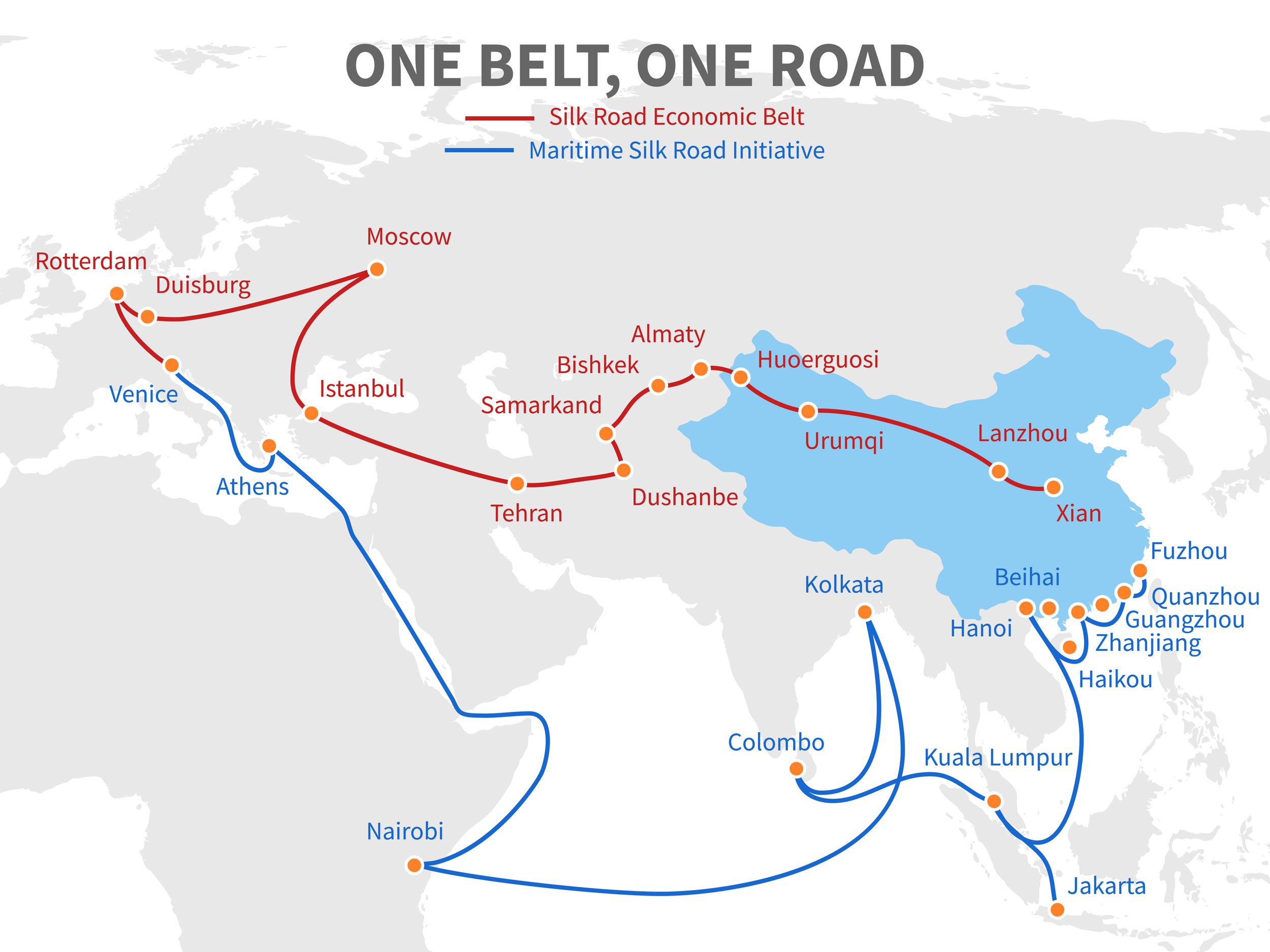
Map of China’s Belt and Road Initiative, highlighting the overland Silk Road Economic Belt and the 21st Century Maritime Silk Road routes linking East Asia, Central Asia, Africa, and Europe.
The International North-South Transport Corridor
But the BRI is only half the picture. Running north to south, the International North-South Transport Corridor (INSTC) is a $21 billion logistics network linking Russia, Iran, and India. Unlike China's top-down megaprojects, the INSTC is a joint venture among its three founding states, with Tehran pushing hardest for expansion as a way to break out of Western sanctions.
The 7,200-kilometer multimodal network slashes the Russia-India shipping distance from roughly 10,000 miles to 4,500, cuts travel time from 40 days to 14, and lowers costs by up to 40%. The corridor is a lifeline for sanctioned economies. Russia uses it to reach Asian and Middle Eastern markets. Iran uses it to escape isolation. For India, it is a strategic hedge, deepening ties to Russia and Iran while reducing exposure to American pressure.
Together, these corridors, the Belt and Road Initiative and the International North-South Transport Corridor, form the backbone of a new trading order, moving energy, commodities, and technology beyond the reach of Western sanctions and military chokepoints.
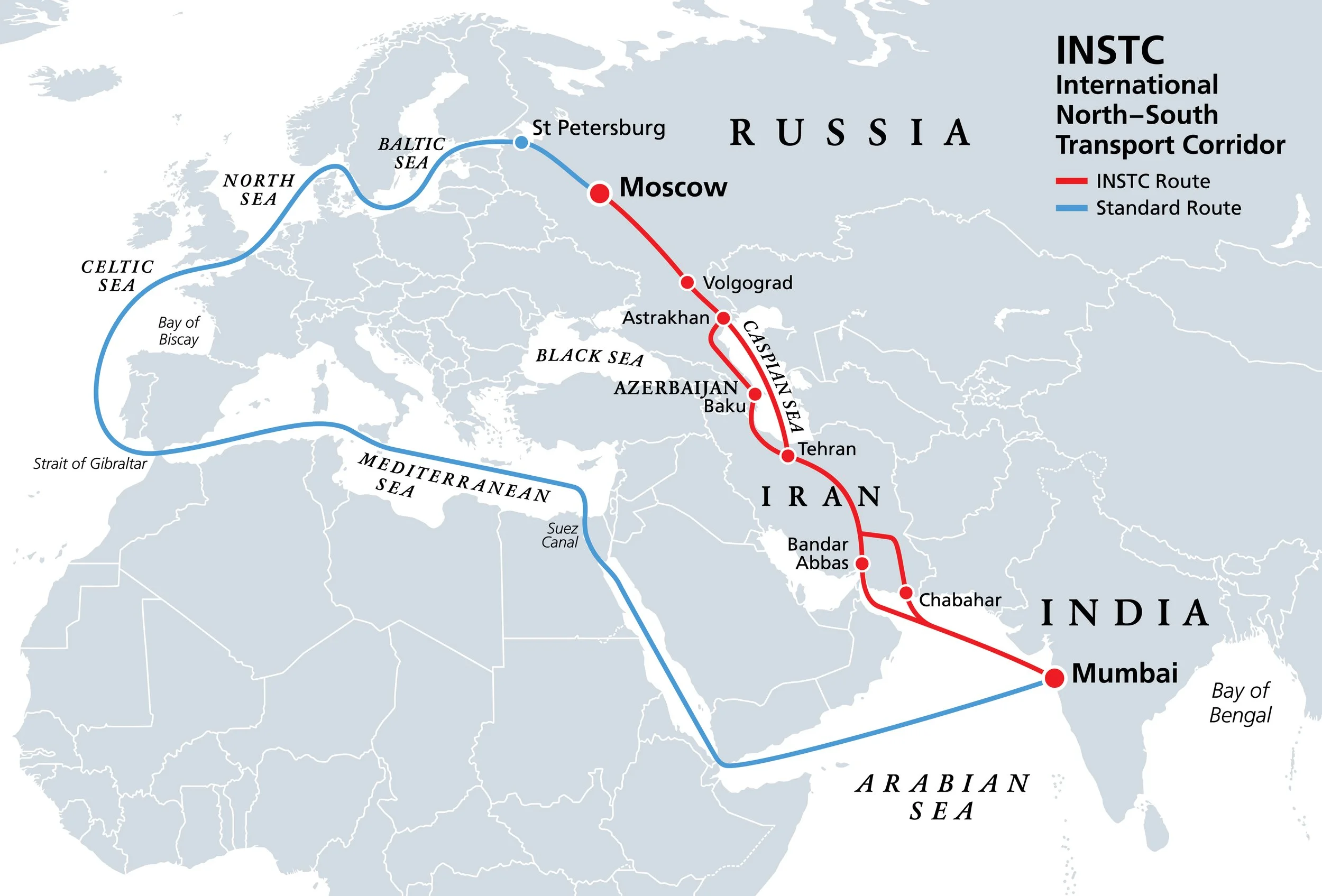
International North–South Transport Corridor trade route from Mumbai to Moscow via Iran.
Iran, The Indispensable Target
China's Belt and Road Initiative runs east to west. The International North-South Transport Corridor runs north to south. Together they form an X across Eurasia, with Iran at the center. To the north, Iran touches Central Asia's vast oil, gas, and mineral reserves. To the south, it commands the Strait of Hormuz, the narrow waterway through which one-fifth of the world's oil must pass. Almost every pipeline, every port, every railway that ties China to Europe, Russia to India, or the Middle East to Asia runs through Iran.
This realignment was not inevitable. It is the result of Washington's own choices. Russia repeatedly tried to join the Western order. In 1989, Mikhail Gorbachev, the last president of the Soviet Union, proposed a “common European home” stretching from the Atlantic to the Urals. In 2000, Vladimir Putin suggested Russia might join NATO “if and when Russia’s views are taken into account as those of an equal partner.” Both offers were ignored. Instead, NATO expanded eastward, and Russia was cast as Europe's eternal threat.
Iran made the same attempt. The 2015 nuclear deal subjected Tehran to the strictest inspections regime ever negotiated. Barack Obama acknowledged that Iran was upholding its commitments. So did the IAEA. So did every U.S. intelligence agency. Three years later, Donald Trump tore up the agreement anyway. Iran was branded a perpetual foe. For Israel, the hysteria over nuclear weapons provides a constant pretext to assert regional supremacy.
The U.S. foreign policy establishment requires enemies. Without them, arms manufacturers lose contracts and politicians lose donors. The system is therefore self‑perpetuating: identify a threat, allocate resources, enforce a U.S.‑led world order through coercion and military power, then move on to the next threat. The victims are millions of civilians around the world, U.S. military personnel sent to fight wars built on lies, and U.S. taxpayers funding it all. The beneficiaries are consistent across wars: the U.S. billionaire class. Harvard international relations professor Stephen Walt and retired Army colonel and Quincy Institute co‑founder Andrew Bacevich have both argued that this isn’t a bug in the system. It is the system itself.
Iran is not simply the next enemy on the list; it is the most strategically consequential one. Destroy Iran and you sever the spine of many of the emerging alternatives to U.S. economic dominance — the energy corridors, trade routes, and financial architecture that BRICS is building outside the dollar system. Iran is a keystone in that structure; weaken or remove it, and much of that architecture buckles.
At the time of this writing, that logic has reached its conclusion. The United States and Israel have launched an unjustified, illegal, and immoral war of choice against Iran. Iran has retaliated. Powerfully. A major regional war is now underway.